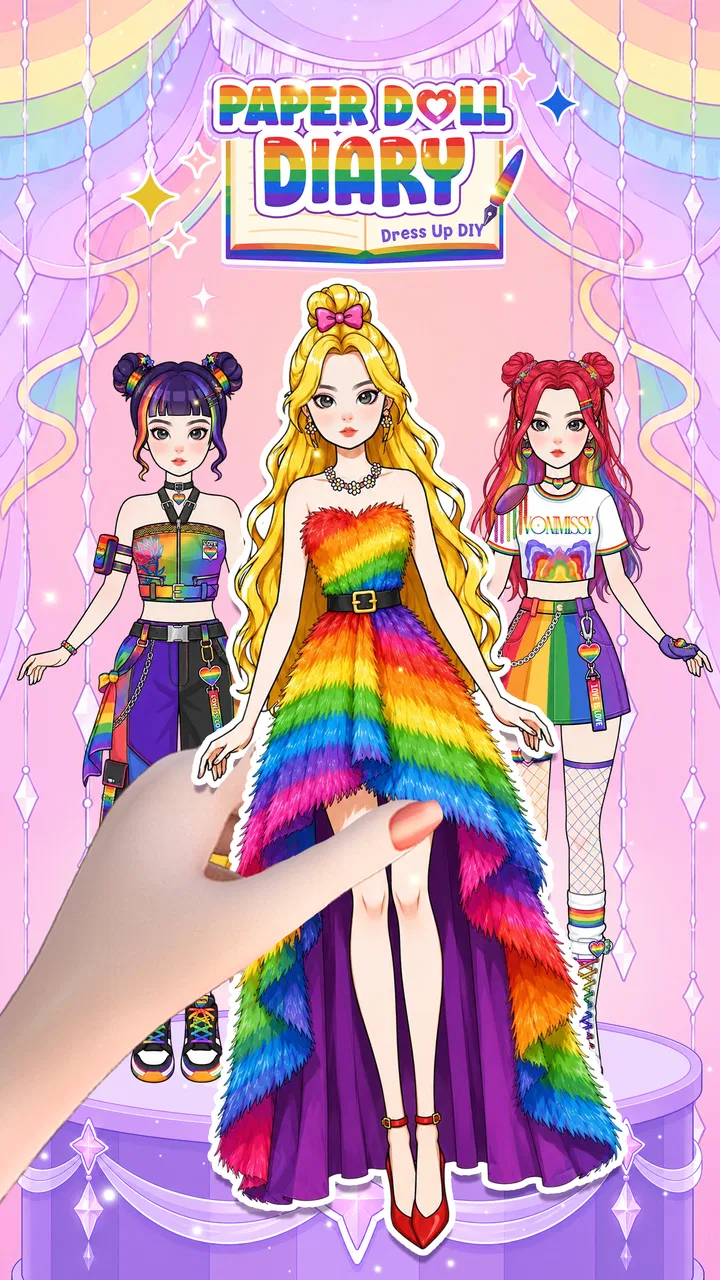
Paper Doll Diary: Dress Up DIY
- 3.8
- Rating
- 50.00M
- Installs
- Free
- Price

 Analysis by App-foxy
I spent time with Paper Doll Diary: Dress Up DIY to understand what makes its central idea work: turning a paper-doll character into a small fashion project. It is a casual game from Bravestars Games, and the appeal is easy to understand. Instead of asking me to master complicated controls or follow a demanding story, it gives me a relaxed space to choose a look, adjust the character’s appearance, and enjoy the result.
That simplicity is both its strongest point and the thing that limits it. I found it pleasant when I wanted a short, low-pressure activity, especially when I was more interested in styling than competition. At the same time, anyone expecting a deep fashion simulator, a large social game, or a highly strategic dress-up experience may find the experience too light. My recommendation depends less on whether you like games in general and more on whether you enjoy making visual choices one outfit at a time.
Why the paper-doll styling idea is the real attraction
The game’s main capability is its DIY fashion focus. I am not simply selecting a finished character and moving on; the pleasure comes from treating the doll as a blank canvas. The outfit, hair, makeup, and overall presentation become parts of one small creative task. That gives each session a clear purpose without making it feel like work.
You May Also Like

 Blood Strike: 2.5 Anniversary
Blood Strike’s Loadouts Turn Every Drop Into a Tactical Gamble
A close look at Blood Strike’s custom loadouts: how fast access to signature weapons reshapes its battle royale rhythm, rewards preparation, and narrows the gap between fights.

 Pandora - Music & Podcasts
Pandora’s Music Is Easy to Start, but Harder to Recover
Pandora’s strength is its low-effort path from a seed to a station. Its weak spot is how much confidence it asks you to place in connection, setup, and quiet recovery.

 8 Ball Pool
 Is Built on Rivalries, Rematches, and Routine
A close look at the rivalries, rematches, shared routines, and unanswered safety questions that turn a quick pool match into a persistent mobile community.

 Samsung Music
’s Quiet Strength Is Playing What You Already Own
Its reach comes less from spectacle than from dependable access to a personal library. That simplicity is both the app’s strongest retention engine and its ceiling.

 AccuWeather: Weather Radar
AccuWeather Review: A Quick, Clear Forecast for Everyday Decisions
For everyday plans, the best forecast is the one you can understand quickly. AccuWeather makes rain timing, radar, and local conditions easy to act on, with a few trade-offs.

 Hill Climb Racing
Why Hill Climb Racing Still Turns Crashes Into One More Run
A tiny car, a bumpy hill and one more upgrade: Hill Climb Racing keeps resurfacing because its simple chaos makes every near-miss feel personal.
More From Our News Desk



For me, the paper-doll format creates a different mood from a conventional makeover game. There is something deliberately simple about arranging a character visually, and that makes the activity approachable. I can experiment without worrying about reflexes, complicated rules, or losing a difficult match. The result feels closer to decorating a page in a digital diary than playing a traditional action game.
The important strength is immediate visual feedback: every styling decision changes the way the doll reads as a complete character. That encourages me to compare choices instead of accepting the first option automatically. A bright outfit may need a calmer hairstyle, while a more dramatic look can work better when the rest of the appearance is restrained.
This is where the game has more value than its short store summary suggests. The individual choices are straightforward, but combining them gives the activity its character. I found myself paying attention to balance rather than simply choosing the most noticeable item. That makes the experience useful for anyone who likes casual creativity and small design decisions.
How the styling process feels during ordinary play
In practice, I approach each session as a quick styling appointment. I begin with the general direction I want, then work through the doll’s appearance and clothing until the result feels coherent. The process is easy to understand, so I do not need a tutorial-heavy introduction before making progress. That matters on a phone, where a game often competes with a few spare minutes.
The best way to play is not to rush through every choice. I get more from the game when I first decide whether I want a soft, playful, polished, or more striking look. Once I have that idea, the individual selections become easier. This small habit also prevents the common dress-up problem of collecting attractive pieces that do not work together.
I also recommend checking the complete appearance before considering a look finished. A detail that seems appealing on its own may dominate the character too much when combined with the rest. Taking a moment to review the whole doll turns the activity from random tapping into a simple visual exercise.
Another useful approach is to treat each attempt as a variation rather than a final answer. If I like the outfit but not the overall mood, I can change one element instead of rebuilding everything mentally. Altering the hair or makeup first often gives a clearer sense of what the look actually needs. This is a small workflow improvement, but it makes the game feel less repetitive.
The game is free to play, which makes trying it straightforward. It includes in-app purchases priced at $1.99 per item, so I would keep that in mind before handing the phone to a child. The content rating is Everyone, and the minimum operating-system requirement is Android 7.0. Those details make it accessible to a broad audience, but accessibility does not remove the need for sensible purchase controls on a shared device.
A realistic everyday use case
I see the game fitting naturally into a short break during the day. Imagine waiting for an appointment with only a few minutes available. A competitive game may demand more concentration than you want, while a long story game may be difficult to pause mentally. Here, I can open the game, work on one paper-doll look, and stop when the session feels complete.
It also works as a quiet activity after a busy day. I do not have to remember a complicated objective or recover from a failed level. The focus stays on arranging the character and deciding whether the final style feels right. For me, that makes it closer to a relaxing creative pastime than a game I would play for challenge.
Parents may also find the format approachable for younger players because the concept is easy to grasp and the age rating is Everyone. Still, I would supervise purchases and pay attention to how the child responds to the game. Some players enjoy making many different looks, while others may lose interest quickly if they want stronger goals or more dramatic progression.
Small techniques that make the experience better
My first practical tip is to build around one anchor choice. That might be a particular outfit or a hairstyle that defines the mood. Once that anchor is selected, I choose supporting elements instead of changing everything at once. This makes the final result more intentional and reduces the feeling that I am simply cycling through options.
My second tip is to compare contrast carefully. If every part of the doll is equally bold, the look can become visually noisy. I get better results by allowing one area to stand out and keeping the neighboring choices more controlled. This is especially useful when I want the character to look styled rather than merely decorated.
My third tip is to use the game as a prompt for personal design ideas. I sometimes recreate a mood I have seen in real clothing, such as a casual weekend outfit or a more carefully coordinated style for an event. The game is not a replacement for a full fashion tool, but it gives me a quick way to test whether colors and shapes feel compatible before I think about them in real life.
A fourth useful habit is to stop when the look is coherent, not when every possible choice has been examined. Dress-up games can encourage endless browsing, and that can turn a relaxing session into a repetitive one. I enjoy Paper Doll Diary more when I set a small goal, finish one character, and leave with a clear result.
Where the game trades depth for convenience
The same simplicity that makes the game welcoming also means it may not satisfy players seeking a substantial progression system. I would not choose it as my main game if I wanted complex challenges, competitive rankings, or a detailed fashion economy. Its appeal is concentrated in the styling activity itself, so the experience depends heavily on whether that activity remains enjoyable to me.
There is also a difference between creative freedom and a large amount of content. A game can let me make attractive combinations without offering the depth of a full character-customization platform. If I want detailed control over every visual element, advanced outfit planning, or a broader simulation of fashion decisions, a more specialized alternative may be a better fit.
The purchase structure is another consideration. Since individual in-app purchases cost $1.99, players who want to access more options may need to think about how much they are comfortable spending. I would avoid treating optional items as necessary for enjoying the basic concept. The free entry point is useful for testing whether the styling loop suits you before making any purchase.
The audience size suggests that the game has reached many mobile players, with over 50 million installs, but popularity does not guarantee a perfect match for every person. Its average rating is 3.6 from around 28 thousand ratings, which feels consistent with a game that appeals strongly to some casual players while leaving others wanting more depth. I would read that as a reason to try the core experience personally rather than assume its scale tells me everything.
The version I reviewed is 1.5.0, and the game was released on March 5, 2024. I mention those details because they help place the experience in context, but they do not change my main conclusion: the quality of the game rests primarily on how much pleasure you get from styling the doll, not on technical complexity.
How it compares with familiar casual alternatives
Compared with a puzzle game, this is much less about solving a problem and more about making a visual decision. A puzzle gives me a clear correct or incorrect direction, while this game is more subjective. That makes it better when I want expression, but weaker when I want a strong sense of challenge.
Compared with a life simulator, it is more focused and easier to pick up. I do not need to manage a broad character routine or follow a long-term story to enjoy a session. The trade-off is that I should not expect the same feeling of building a persistent world or developing a character over a long period.
Compared with a competitive fashion game, Paper Doll Diary feels calmer. I can concentrate on the look itself rather than worrying about opponents or performance pressure. Players who enjoy judging, ranking, or timed decisions may prefer another option, but anyone who finds those systems stressful may appreciate this gentler approach.
Compared with a simple avatar creator, the game gives the styling process more purpose. I am not only adjusting a profile picture; I am completing a small fashion-themed activity. However, a dedicated avatar editor may offer more precision if my goal is to create a character for use outside the game.
Who will enjoy it most, and who should skip it
I think the strongest audience is people who like casual dress-up games, visual organization, and short creative sessions. It is particularly suitable for players who want something understandable within moments and who enjoy making several slightly different versions of a character. Younger players may find the paper-doll idea inviting, while adults may appreciate it as a low-pressure distraction.
It is also a good choice for anyone who likes experimenting without being judged by a difficult scoring system. I can focus on whether I like the result, which gives the experience a personal quality. That makes it a pleasant recommendation for a friend who wants a relaxing mobile game rather than another demanding obligation.
I would suggest skipping it if you need constant novelty, strategic depth, or a strong narrative reason to return. Players who prefer action, multiplayer competition, or detailed simulation will probably get more satisfaction elsewhere. I would also be cautious if you dislike browsing cosmetic options or if you expect every dress-up game to provide extensive customization at no cost.
For families, the Everyone rating is reassuring as a starting point, but the purchase system still deserves attention. I would set expectations clearly before letting a child explore the game, especially because optional items are sold individually. That is not a reason to reject the game, but it is part of using it responsibly.
My final view after focusing on the core loop
Paper Doll Diary: Dress Up DIY works best when I treat it as a compact creative activity rather than a full-scale fashion simulation. Its paper-doll styling capability gives each session a clear center, and the immediate visual result makes even a short play period feel complete. I like that I can experiment with a character’s overall mood without needing advanced gaming skills.
Its limitations are equally clear. The experience may feel too light for players who need demanding objectives, deep progression, or a large social component. The individual in-app purchases also mean I would approach optional spending carefully. Those trade-offs are acceptable to me because the free casual format is easy to understand and the styling loop has a relaxed charm.
My recommendation is simple: try it if you enjoy putting together outfits, adjusting a character’s appearance, and making small visual decisions during spare moments. Skip it if you want a game built around challenge or long-term simulation. For the right player, the best reason to install it is the satisfaction of turning a simple paper doll into a look that feels deliberately yours.
FAQs for Paper Doll Diary: Dress Up DIY
01What is Paper Doll Diary: Dress Up DIY and what can I do with it?
Paper Doll Diary: Dress Up DIY is a creative app that allows users to design and dress up virtual paper dolls. You can customize dolls with a variety of outfits, accessories, and hairstyles. The app provides a platform for creativity, enabling users to explore fashion design and styling in a fun, interactive way.
02Is Paper Doll Diary: Dress Up DIY suitable for children?
Yes, Paper Doll Diary: Dress Up DIY is designed to be child-friendly. It offers a safe and engaging environment for kids to express their creativity. The app features simple controls and a wide range of customization options that are suitable for children, making it an excellent choice for young fashion enthusiasts.
03Does Paper Doll Diary: Dress Up DIY require an internet connection?
No, Paper Doll Diary: Dress Up DIY does not require a constant internet connection. Once downloaded, you can enjoy the app's features offline. However, some updates or additional content might need an internet connection to download. It's best to check the app's requirements for any online features.
04Are there any in-app purchases or advertisements in Paper Doll Diary: Dress Up DIY?
Paper Doll Diary: Dress Up DIY may include in-app purchases that offer additional outfits, accessories, or features. Additionally, there might be ads displayed within the app. It's advisable to review the app's store page for details on in-app purchases and advertisements, especially if a child will be using the app.
05How can I save and share my creations in Paper Doll Diary: Dress Up DIY?
The app allows users to save their designs to a gallery within the app. You can also share your creations directly from the app through social media or messaging platforms. This feature enables you to showcase your fashion designs to friends and family easily, promoting social interaction and creativity.
Pros
- Intuitive interface for easy navigation.
- Extensive wardrobe options for creativity.
- Regular updates with new content.
- Offline mode available for uninterrupted play.
- Supports both Android and iOS platforms.
Cons
- In-app purchases can be expensive.
- Limited free content for non-paying users.
- Some outfits require internet connection.
- Occasional ads interrupt gameplay.
- No multiplayer or social sharing features.

Paper Doll Diary: Dress Up DIY
Gallery